
They Couldn’t Burn the Code
I went looking for aliens and found the ancestors instead.

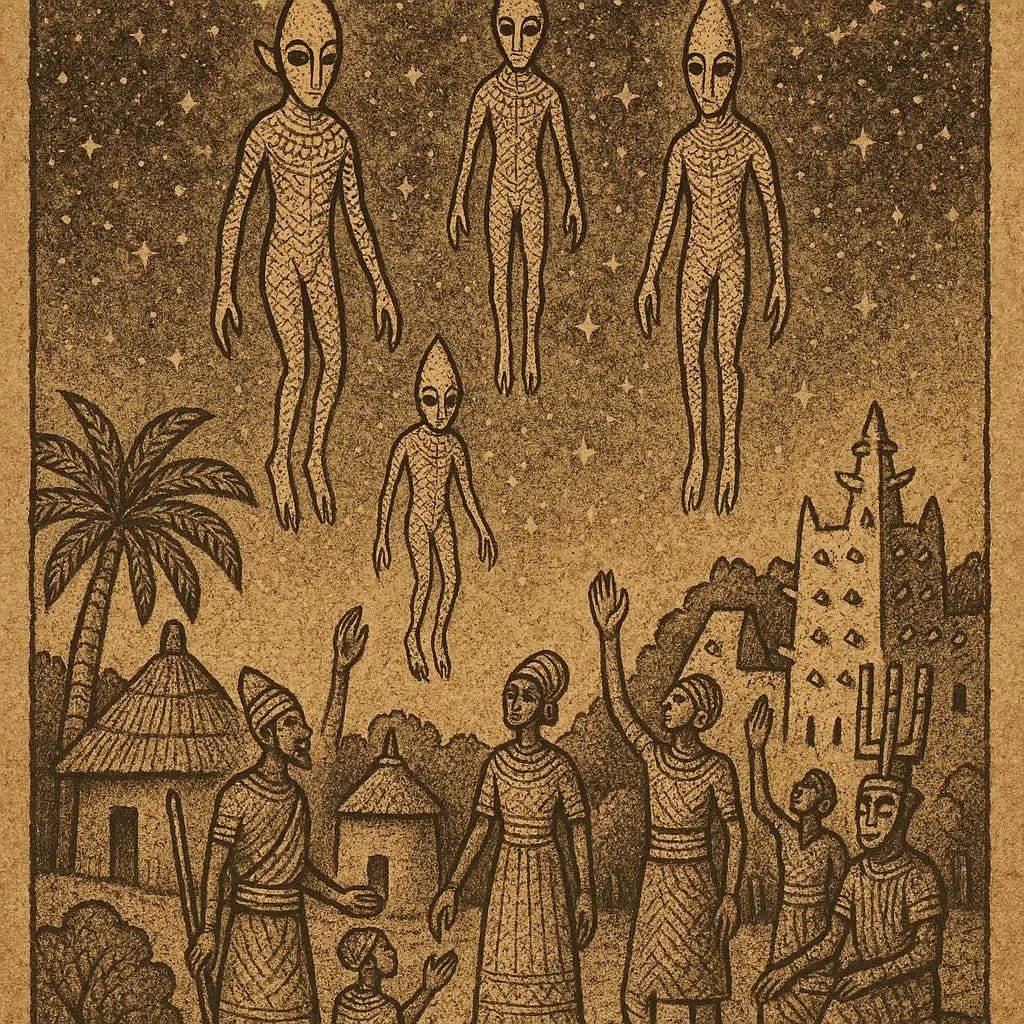
I first came across an article about the Dogon of Mali, a people of the central plateau who, according to the French anthropologist Marcel Griaule, held a secret cosmology passed through their elders.
In that cosmology was a star.
Not the bright one everybody can see—Sirius, the brightest in our sky—but a second one.
Invisible. Impossibly dense.
Circling the first on a fifty-year orbit.
A companion star that Western astronomers couldn’t even photograph until 1970.
And the Dogon, the story goes, had been talking about it for generations.
West Africans knew the sky better than the people who built the telescopes.
Knowledge that arrived from somewhere it had no business arriving from.
The Dogon spoke of the Nommo—amphibious beings, half-fish, who came down from the heavens and gave them this knowledge.
Sky-teachers. Star visitors.
I let myself believe the most seductive version of the question: what if they knew something the world has spent five hundred years refusing to credit them with?
I want to tell you that the version is true. It would make a better headline. But I owe you better than a headline, so let me tell you what I found when I kept reading.
The story doesn’t survive scrutiny. Not the literal version.
In 1991, a Dutch anthropologist named Walter van Beek published a restudy in Current Anthropology—he went and lived with the Dogon, the same people, looking for the elaborate star lore Griaule had reported decades earlier.
Griaule claimed that roughly 15% of Dogon men were initiated into this knowledge. It should have been easy to find.
Van Beek couldn’t find it.
Not the way Griaule described it.
The Dogon he spoke with disagreed with one another about which star was even meant.
Some pointed at Venus.
And the ones who did describe a companion to Sirius told him, plainly, that they’d learned about it from Griaule himself.
Add to that a French astronomical expedition that camped in Dogon territory for five weeks in 1893 to watch an eclipse and the detail that Sirius B was sitting in popular astronomy books by the 1930s, and you have a likelier story than star-visitors: a brilliant ethnographer who wanted so badly to prove the sophistication of African thought that he asked leading questions until he got the answer he came for and a people generous enough to meet him halfway.
Here’s where most writers stop. Debunked. Myth busted. Moving on.
I’m not going to stop there, because the debunking is the lazy part.
The thing worth saying is harder, and it cuts the other way.
The entire genre that the Dogon story belongs to—ancient astronauts, lost knowledge gifted from the stars—has a rotten foundation, and the rot is racism. Look at which civilizations get the alien treatment.
It’s never the cathedral builders.
It’s the pyramids at Giza, the moai of Rapa Nui, and the stone cities of Great Zimbabwe—the works of brown and Black people that Europe could not bring itself to believe brown and Black people made.
The “aliens did it” theory is a compliment with a knife in it. It marvels at the achievement precisely so it can take it away from you and hand it to someone in space.
So I had it backward on that first seductive night. We all do. The question was whether the visitors came. The question—the one that actually honors the people I was reading about—is what did we already carry?
Move your eyes down from the sky to the hands.
A few hundred miles from Dogon country, the Yoruba have practiced Ifá divination for centuries.
Set aside whatever the word “divination” conjures for you and look at the structure, because the structure is the point. A priest, the babalawo, casts sacred palm nuts or a divination chain.
Each cast resolves to one of two states. Do it the prescribed number of times, and you arrive at one of 256 configurations—16 principal signs, each crossed with 16 again.
Each configuration, each odù, opens onto a vast body of memorized verse: parables, histories, ethical instruction, and cosmology.
Read that again. Two states. Compounded into 256 outcomes. A repository of human knowledge addressed and retrieved through a fixed code.
That’s binary. That’s a sixteen-bit address space resolving to a database.
The Yoruba were running a knowledge-retrieval system on a base-two architecture centuries before Western mathematics formalized binary logic and a long, long time before anyone soldered it into silicon.
This isn’t me being romantic.
Computer scientists have published formal analyses of Ifá’s algebraic structure—mapping the odù to matrices and uncovering the group properties hidden within the ritual.
One paper argues, flatly, that systems like this “should be appreciated as intelligent indigenous technology.” UNESCO lists Ifá among the masterpieces of humanity’s intangible heritage.
I’m not collapsing the spiritual into the computational or pretending a babalawo is “really” a programmer.
The opposite.
I’m saying the division we inherited—sacred over here, technical over there, intuition on one side and engineering on the other—is a recent and provincial way to cut the world, and our ancestors never cut it that way.
The drum languages of West Africa encoded sentences in tone and rhythm, sending information across distances faster than a runner could carry it. The cosmologies were built to be taught, repeated, and transmitted intact across generations with no written text at all.
These are technologies of the spirit in the most literal sense: systems engineered to store, process, and move knowledge. The genius was never in the stars. It was in the hands, and it was human, and it was ours.
Now hold that, and remember what was done to the people who carried it.
The transatlantic slave trade was not only a theft of bodies and labor.
It was an engineered erasure — a deliberate, sustained attempt to delete a people’s operating system.
Mix the captives so no two who shared a language stood in the same hold.
Ban the drums, because the enslavers correctly understood the drums were a network.
Forbid the gatherings. Outlaw, under threat of the lash, the practice of any tradition carried from home. The slave codes were, among their other horrors, a program for wiping cultural memory clean.
It did not work.
It survived in coded form. In the praise houses and the slave quarters, West and Central African spiritual practice braided itself into Christianity and went underground, wearing borrowed clothes.
The ring shout—the counterclockwise circle dance the historian Eileen Southern traced in the records to the early nineteenth century, which white clergy nervously called “a relic of some African rite”—is ancestor veneration and spirit communion preserved within a form the overseer would read as harmless Christian enthusiasm.
Hoodoo, what the scholar Katrina Hazzard-Donald studied as the “old African American religious system,” kept the herbal knowledge, the Kongo cosmogram, and the conjure, all of it transmitted through coded language and disguised practice, with Christian scripture used as protective camouflage over an African core.
The Gullah Geechee of the Sea Islands held the line so well that the McIntosh County Shouters in Georgia are still performing the ring shout today.
Sit with the engineering of that.
People with everything stripped from them—language, name, lineage, and the drum itself—encoded their most precious systems into forms their captors couldn’t read; stored them in the only medium that couldn’t be confiscated, the body and the voice; and transmitted them across generations through a firewall built specifically to destroy them.
That is not folklore that has lingered. That is the single most impressive act of data preservation under hostile conditions I know of in human history. They couldn’t burn the code. It was written somewhere the fire couldn’t reach.
And here is where the star-visitors come back, because we never really left them.
In the 1990s, a Detroit techno duo named Drexciya—James Stinson and Gerald Donald—pressed a myth into their record sleeves. Beneath the Atlantic, they wrote, there is a nation.
It is peopled by the water-breathing children of pregnant African women thrown from the slave ships or who jumped during the Middle Passage. Those infants never drowned. They were born to the water. They built a civilization down there in the dark, in the very grave the trade dug for them, and they thrived.
No one thinks this literally happened. That’s not what it’s for. The cultural critic Mark Dery had a word for what it is—he coined “Afrofuturism” in the mid-nineties for exactly this: Black imagination reaching past a stolen history into a constructed future, remixing past and present and what-comes-next all at once.
Drexciya took the worst wound in the diaspora’s memory and, instead of only mourning it, built a mythology of survival and power on the ocean floor.
Scholars have noted that the Drexciyan beings—amphibious, born of the sea—rhyme almost exactly with the Dogon’s fish-like Nommo, the sky-teachers I started this essay chasing.
The duo drew, too, on Mami Wata, the African water spirit who crossed the Atlantic in the holds along with everyone else.
Watch the full circle.
The “alien” myth that opened this piece, the one that doesn’t hold up as history, returns as something truer than history: a tool. Sun Ra insisted he was from Saturn.
Octavia Butler is writing Black women into deep time and distant worlds.
Drexciya is raising a kingdom from the drowned. This is the same technology of the spirit that built Ifá and survived the crossing, still running—the capacity to imagine forward as an instrument of survival and to insist on a future precisely when the present is engineered to deny you one.
Speculation, for a people who were never supposed to have a tomorrow, is not escapism. It’s infrastructure.
Which brings me, finally, to now. To the room I actually live in.
I spend my days telling women — Black women especially — that they can build with these new machines.
And I watch the same lie get told, in new packaging, every single day: that we are not technical. That we are not natural builders.
That is when the automation comes into play; we are the soft target—the first to be displaced, the last to be retrained, the labor most easily dismissed as replaceable.
I’ve spent a lot of words on that lie elsewhere, and I won’t relitigate it here. Regulars know the shape of it.
I just want to set it next to everything above and let the absurdity ring.
The tech-forward instinct did not arrive with a boot camp.
It is not a thing we are belatedly being granted access to by people who got there first.
We ran binary knowledge engines before the word “binary” existed in the languages now used to gatekeep us. We invented data preservation under conditions that would have erased anyone less ingenious.
We have been imagining and building our way out of impossible rooms for as long as there have been impossible rooms. The descendants of the people who out-engineered total erasure are not going to be quietly automated out of the future. We are, if anything, the most qualified people in the building.
June is the month we mark emancipation in this country—Juneteenth, the long-delayed news of freedom finally reaching the people it belonged to. I used to think of that day as being about what was taken off: the chains, the codes, the legal fact of bondage.
I think about it differently now.
Freedom is also a question of what survives to be freed.
When the word finally came, the people who walked into it were not blank.
They carried a whole inheritance the system had tried and failed to delete—the rhythms, the cosmologies, the conjure, the ring still turning counterclockwise in the praise house, and the imagination that would one day raise a city under the Atlantic.
The code came through the fire.
It came through to us.
So no, I don’t think it’s my place to draw these lines.
I think it might be the most honest work I've done. The inheritance was never behind us, a thing to be nostalgic about. It’s an instruction.
It’s a spec sheet for what we build next.
We were the first technologists. We are not done.